How to Choose the Right Rug Size for Every Room in Your Home
Rugs are one of the few purchases that can make a room feel finished, or quietly wrong in a way that is hard to name. Nine times out of ten the culprit is size. A rug that is too small turns a generous seating area into an island of pattern surrounded by bare floor, while the same furniture on a rug 60cm wider suddenly looks deliberate and calm.
The good news is that this is measurable. You do not need an eye for design so much as a tape measure, a roll of masking tape and twenty minutes on the floor. Below is how to work out the right size for each of the main rooms in a house, and what to do when the rug you love comes in a single size.
Start with the floor, not the rug
Measure the room first, then measure the main piece of furniture in it — the sofa, the bed, the dining table — and note how much space sits around each. Sketch a rough plan on paper, or mark the outline on the floor with masking tape. Walking around a taped rectangle for a day tells you more than any showroom ever will.
Two measurements get forgotten again and again. First, doors: a rug with a deep pile can catch on a low door or stop it opening fully, so check the clearance and allow a centimetre or two. Second, fixed features — fireplace hearths, radiator valves, floor vents, the swing of a wardrobe door. A rug that stops neatly 20cm short of a hearth will always look more considered than one tucked underneath it.
It helps to know the sizes you are likely to be choosing between. Common widths and lengths include 120 x 170cm, 160 x 230cm, 200 x 290cm, 240 x 330cm and, for generous rooms, 300 x 400cm. Working backwards from the space you need, rather than forwards from whatever is on offer, keeps the decision simple.
Living rooms: anchor the seating
Furniture should sit on the rug, not float beside it. The reliable rule is that at least the front legs of every seat in the arrangement belong on the rug, with back legs off if the room is small. In a larger room, fit the whole group on and leave 30–45cm of rug visible behind the sofa so it reads as a considered edge rather than a stray corner.
A rug is the one thing in a room that everything else stands on. If it does not reach, nothing else quite lines up.
For a three-seater sofa with two armchairs, think in terms of 200 x 290cm. For a generous room or a corner sofa, 240 x 330cm is often the better answer. If the rug must be smaller, keep the seating tight and let the front feet rest just on the edge — a deliberate grouping rather than a scatter of furniture.
Open-plan and awkward spaces
Use the rug to define the zone. In a long room, two rugs read better than one enormous one: keep them the same size and style, or choose one patterned and one plain to stay calm. Leave roughly 30cm of bare floor between them so the join looks intentional. Where a room is wide but shallow, a rectangle running the length of the seating stops the proportions looking squat.
Bedrooms: go bigger than you think
Bedroom rugs are almost always bought too small. Whatever size you have in mind, go up one. A rug that a bed sits on should extend 50–60cm beyond each side, which for a double usually means 200 x 290cm and for a king 240 x 330cm. Position it so the rug begins around two-thirds of the way down the bed, or at the foot, then runs well past the sides.
If a large rug is not practical, skip the single-under-the-bed approach and use a runner along each side instead, around 70 x 200cm, running from bedside table to the foot of the bed. It is a neat solution in rooms with fitted wardrobes on both walls, where a wider rug would foul the doors.
When the bed sits against a wall
Place a runner along the open side only, so your feet land on something soft when you get up. In a small box room or a single, a 120 x 170cm rug at the foot of the bed, with the bed's front legs resting on it, gives the room a centre without swallowing the floor.
Dining rooms: the chair test
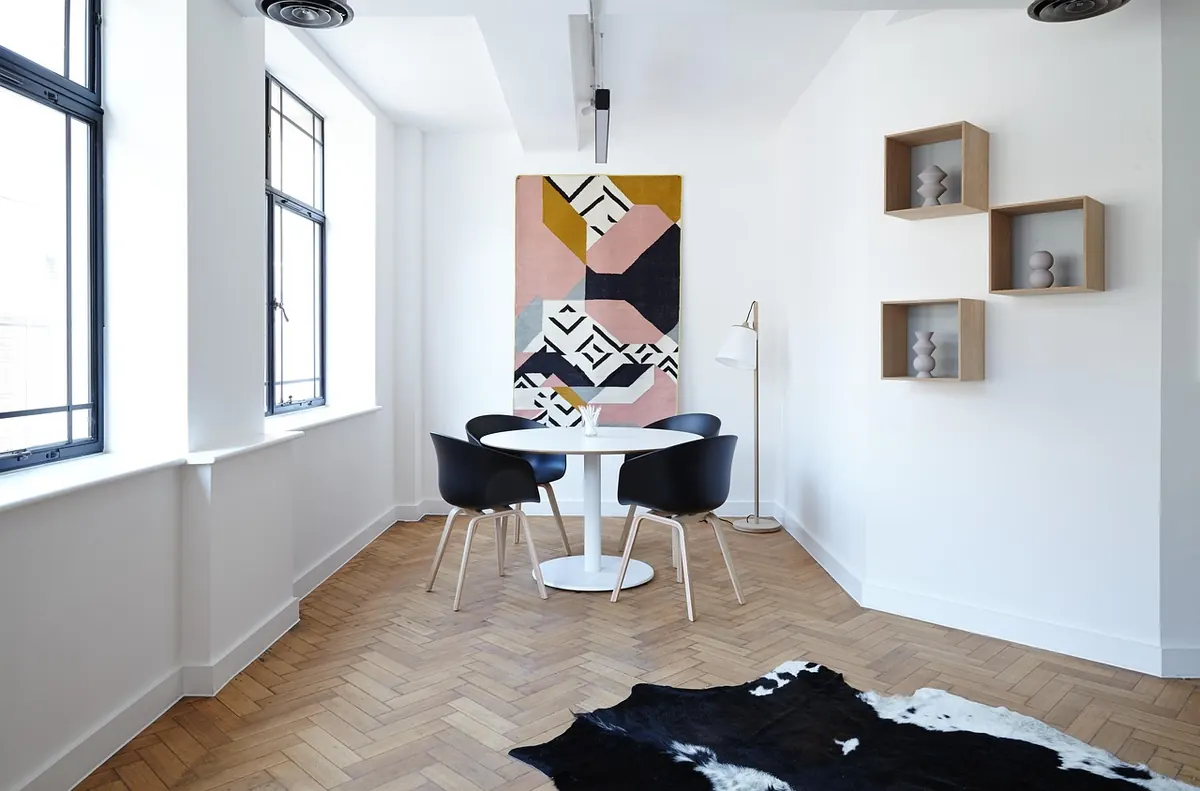
The rule here is simple and worth following: a rug should extend 60–70cm beyond every edge of the table, so a chair can be pulled out and still stay on the rug. Get this wrong and back legs will drop off the edge every time someone stands up, which is both irritating and unkind to wooden floors. A table seating six usually points to 200 x 290cm; four chairs sit comfortably on 160 x 230cm.
Shape matters too. Match a rectangular rug to a rectangular table and a round rug to a round one. Choose a flat or short pile — a deep shag under a dining table is difficult to keep clean and awkward to slide chairs across. If the room doubles as a thoroughfare, leave at least 60cm of bare floor between the rug edge and the wall.
Hallways, kitchens and narrow rooms
In a hallway, allow 10–15cm of floor to show on each side of a runner and keep it clear of doors. For kitchens, a washable flatweave mat in front of the sink at around 60 x 90cm, or a runner along the worktop side, is enough; avoid anything with a loose weave near a cooker. Bathrooms and utility rooms want a non-slip backing as a matter of course, since hard flooring and damp feet are a poor combination.
When the right size does not exist
Layer. A smaller patterned rug over a large plain jute or sisal base gives you the pattern you want and the footprint the room needs, and it is far easier to clean than one huge statement piece. Runners are another fix: two matching runners down either side of a bed or sofa can cover nearly the same ground as a single large rug.
Alternatively, buy the larger size and have it trimmed and re-bound by a specialist. It is often cheaper than it sounds, and it means the rug fits the room rather than the room bending around the rug.
A last check before you buy
- Tape the proposed size on the floor and live with it for a day before ordering.
- Measure door swings, hearths, vents and radiator valves.
- Check the pile height under any door that opens inwards.
- Buy a non-slip pad on wood or tile, cut a few centimetres smaller than the rug so it stays hidden.
- Think about the rug as the largest block of colour in the room — if the walls are busy, keep it quiet.
- Confirm the returns policy before you commit.
Get these basics right and the rug will do the quiet work that good textiles always do: pulling the furniture together, softening hard flooring and making a room feel as though someone thought about it. If you have a floor plan and a tape measure, you already have everything you need.